



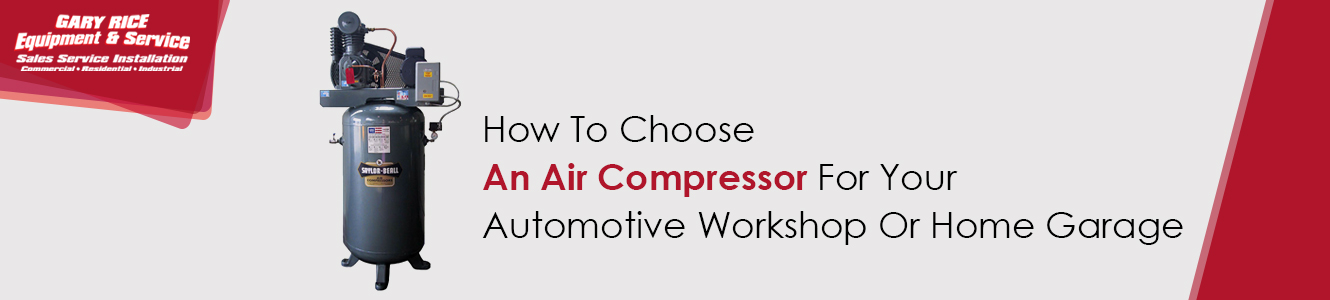
Choosing an air compressor can be extremely difficult if you don’t know much about it. It’s essential to choose the right air compressor for the kind of job you want to perform. Air compressors power a wide range of automotive equipment and tools over a wide range of applications. You require maximum horsepower for the job to get done. Your investment is valuable and you don’t want it to go down the drain. You need to have the right knowledge in order to get the air supply right for your automotive equipment and pneumatic tools. Air tools are more powerful and deliver higher torque than traditional electric tools. They reduce the amount of time spent on a project. Cutting, sanding, grinding, painting, polishing, and inflating – a garage air compressor makes all these jobs easier and less time-consuming. The information below will help you make an informed choice about compressed air systems.
1. Identify the requirements
Are you going to use air compressor systems for your professional automotive workshop or home garage needs? You’ll probably want a piston compressor with a tank if you plan to power heavy-duty machinery, while you may want a portable compressor without a tank if you plan to use it for your home garage. Consider requirements like volume and pressure of any automotive equipment tools you may be using. Heavy-duty tools require much more volume and pressure. If you fail to choose an air compressor that’s powerful and large enough for your intended use, you’ll find yourself waiting for the tank to fill up. This will decrease work efficiency. For tasks like airbrushing, portable air compressor with a 5-liter tank capacity and 30 PSI of air pressure should be adequate.2. Choose between portable and piston compressors
There are two kinds of air compressors. Piston-type compressors depend on a motor which builds air pressure. This compressor stores compressed air in tanks. Portable compressors don’t have tanks and run continuously to deliver air. Furthermore, there are two variants of piston-type compressors. Single-stage compressors use only one piston to compress air and top out at 150 PSI. Two-stage compressors use two pistons to deliver continuous air pressure and cap out around 200 PSI. Single-stage compressors are appropriate for heavy duty applications at home. Two-stage compressors are mostly used in industrial settings for continuous usage. Portable air compressors are more suitable for a home garage and light home usage. This includes powering caulk guns, glue guns, spray guns, and inflating tires.3. Know the horsepower (HP) of the air compressor
Air compressors have a common horsepower range between 1.5 and 6.5 HP. Larger HP capacity air compressors exist, but they’re mostly used in industries that produce greater horsepower. Small-scale uses don’t require as much horsepower as compared to industrial uses. Horsepower is a valuable factor in determining your air compressor’s CFM (cubic feet per minute) rating, which is a valuable factor.4. Pay attention to CFM (cubic feet per minute)
CFM is a measure of volumetric flow. CFM changes depending on the PSI of the compressor. Look for a standard CFM (SCFM) when evaluating compressors. Standard CFM is measured as 14.5 PSIA, at 68-degree Fahrenheit (20-degree Celsius), with zero percent relative humidity. After you’ve got the SCFM of all your air tools that you’ll be using simultaneously, add up their SCFMs and add 30 percent to that as a safety buffer. This will give you the maximum required CFM usage you’ll need. When choosing an air compressor, you want to get close to this number so that you don’t waste time or money on mismatched performance.5. Consider Portability and Space
Air compressors can be small, portable items or more powerful fixtures. Portability is a lot more convenient. If the air compressor stays in one corner of the garage, you may have to use a longer hose to have a higher capacity compressor. Consider the compressor’s purpose. Will you be using this compressor to supply a nail gun on the roof or just fill tires in the garage? 6. Determine your power source If you have the luxury of electricity at all times, it’s best to choose a drive system with an electric motor. If your environment lacks electricity, a gasoline engine compressor will suit you best. 7. How large should your tank be if you’re using a piston-type compressor? If you need an air compressor for a short burst of time, you can get away with having a small tank. If you’ll be working for extended periods of time with your compressor, you’ll want a bigger tank. Tank sizes are usually measured in gallons. Two Important Steps To Follow Before Selecting an Air Compressor You should determine two things before you choose an air compressor.- Determine the environment where you’ll be operating the compressor. Where do you plan to use the machine and tools – indoors or outdoors? Will your workshop be located in your garage or in a stand-alone workshop?
- Determine the amount of power required to run your operations. Will you be working close to power outlets, running your equipment on batteries, or using fuel?
Comments are closed